
2026 Best Construction Site Equipment for Global Buyers?
For global buyers, the best construction site equipment is not always the biggest or newest machine. It is the machine that fits the work, terrain, crew, and local support network. A compact excavator may suit a tight urban site, while a wheel loader can move materials efficiently across a broad, firm surface. Conditions matter. Rain, dust, steep access roads, and long shifts can quickly expose a poor equipment match.
Construction equipment management author Mike Vorster’s guidance can be paraphrased as a simple buying principle: judge equipment by productive availability, utilization, and lifecycle cost—not purchase price alone. That means checking fuel use, service intervals, parts access, operator visibility, and repair support before comparing offers. Ask how quickly common wear parts can reach the site. Look closely at the service plan. A low-cost machine can become expensive when a small fault keeps it idle for days.
This guide examines leading equipment categories for 2026, from earthmoving machines to lifting and material-handling tools. It also considers total ownership costs, safety features, dealer coverage, and practical technology such as fleet monitoring. Specifications are useful, but they do not tell the whole story. A polished brochure cannot prove local parts availability. Buyers should verify claims with dealers, service records, and job-specific trials where possible. No shortlist is perfect. The right choice depends on the project—and sometimes the site changes after the order is placed.
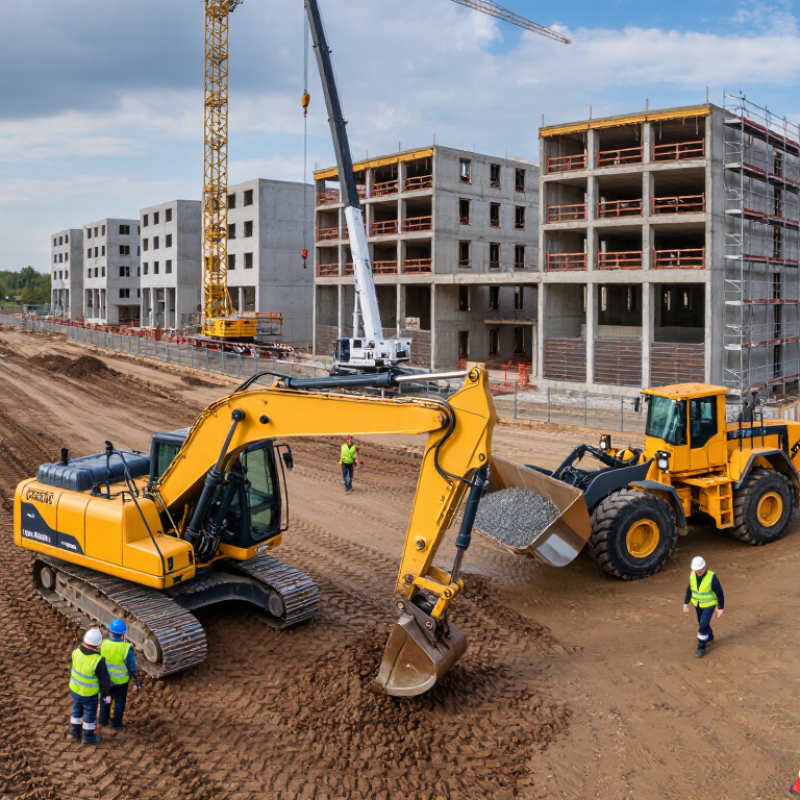
Global Buyer Criteria: ILO Reports 2.93 Million Work-Related Deaths Annually
2026 Best Construction Site Equipment for Global Buyers?
Global Buyer Criteria: ILO Reports 2.93 Million Work-Related Deaths Annually
Construction equipment should be judged by its safety value, not only its lifting capacity or fuel efficiency. The International Labour Organization estimates 2.93 million work-related deaths each year, alongside about 395 million non-fatal occupational injuries. These figures make risk reduction a purchasing priority, especially on crowded sites with moving machinery, unstable ground, dust, and poor visibility.
For 2026, global buyers should examine equipment with effective guarding, emergency stops, reverse alarms, proximity detection, and clear operator controls. Dust suppression and low-noise systems also matter near workers and surrounding communities. The ILO’s Safety and Health at Work report supports a prevention-based approach, while ISO 45001 principles emphasize hazard identification and continual improvement. Buyers should request inspection records, maintenance intervals, operator training requirements, and independent safety test results.
A practical warning: smart monitoring does not replace supervision. A sensor may fail in mud, rain, or heavy traffic. Battery-powered equipment can reduce local emissions, yet charging access may be unreliable on remote projects. This is where procurement decisions become difficult. Buyers should test machines under real site conditions, not only in demonstrations. The safest choice may be slower, simpler, and easier to maintain. That judgment deserves more attention.
2026 Best Construction Site Equipment for Global Buyers? - Global Buyer Criteria: ILO Reports 2.93 Million Work-Related Deaths Annually
Safety context: The International Labour Organization (ILO) estimates that 2.93 million workers die each year from work-related accidents and diseases worldwide. This is a global estimate across industries, not a construction-only figure. Use the criteria below to compare equipment against the hazards and conditions of each project.
| Equipment category | Typical site use | Key hazards to assess | Practical buyer criteria | Relevant standards to verify | Evidence to request before purchase |
|---|---|---|---|---|---|
| Excavators | Earthmoving, trenching, loading, and site preparation. | Struck-by incidents, machine rollover, falling objects, blind spots, and contact with underground services. | Match machine size and attachments to the task; assess visibility, reversing aids, access steps, seat belt, guarding, and rollover protection. Confirm attachment compatibility and safe lifting limits where lifting is planned. | ISO 20474 series for earth-moving machinery; ISO 3471 for rollover protective structures; ISO 3449 for falling-object protective structures, where applicable. | Applicable conformity documents, operator and maintenance manuals, attachment ratings, inspection records, and details of protective structures fitted. |
| Wheel loaders and site dumpers | Moving bulk materials and transporting loads around a site. | Vehicle collisions, reversing incidents, rollover, falling loads, and pedestrian interaction. | Check rated capacity and stability information for the intended load; prioritize clear visibility, effective braking, seat belts, suitable protective structures, and a site-compatible warning system. | ISO 20474 series for applicable earth-moving machinery; ISO 3471 and ISO 3449 for relevant protective structures. | Capacity and stability information, operator instructions, maintenance schedule, and inspection evidence for brakes, steering, tires, and protective structures. |
| Mobile cranes | Lifting and positioning materials, plant, and structural components. | Overturning, dropped loads, contact with overhead power lines, rigging failure, and people entering the lifting zone. | Verify rated-load information and configuration limits; assess load-moment and overload protection, setup requirements, ground-bearing conditions, and compatibility with lifting accessories. Plan lifts for the actual site layout. | ISO 4301 series for crane classification; ISO 9927 series for crane inspections. Applicable national lifting regulations also need to be checked. | Load charts, operating and setup instructions, inspection and maintenance records, configuration details, and documentation for lifting accessories. |
| Mobile elevating work platforms (MEWPs) | Temporary work at height, including installation, inspection, and maintenance. | Falls, entrapment, overturning, collisions, and contact with overhead hazards. | Select a platform suited to required working height, reach, ground conditions, and indoor or outdoor use. Check guardrails, emergency lowering, controls, stability limits, and safe access and rescue arrangements. | ISO 16368 for mobile elevating work platforms; local work-at-height and equipment requirements should also be verified. | Rated platform capacity, operating limits, manuals, inspection and maintenance records, and instructions for emergency lowering and rescue. |
| Forklift trucks | Handling pallets and materials in storage, delivery, and construction zones. | Pedestrian collisions, falling loads, tip-over, and unsafe operation on uneven or sloped ground. | Match truck type, capacity, and attachments to loads and surfaces. Check visibility, braking, stability information, operator protection, pedestrian controls, and whether the truck is suitable for the terrain. | ISO 3691 series for industrial truck safety requirements and verification; confirm the applicable part for the truck type. | Rated capacity plate, attachment capacity information, operator instructions, maintenance history, and inspection records. |
| Compaction rollers | Compacting soil, aggregate, or asphalt during road and ground works. | Rollover, collisions, vibration exposure, noise, and work near edges or slopes. | Check suitability for the material and site conditions; assess visibility, rollover protection, access and egress, vibration information, and operating limits on slopes and near edges. | ISO 20474 series for applicable earth-moving machinery; ISO 3471 for rollover protective structures, where applicable. | Operating limits, vibration and noise information, maintenance instructions, and inspection evidence for protective structures and safety systems. |
| Portable generator sets | Temporary power for site tools, lighting, and other electrical equipment. | Electric shock, fire, burns, carbon-monoxide exposure, noise, and unsafe connections. | Choose output and connections for the intended loads; assess electrical protection, earthing arrangements, weather protection, ventilation, fuel handling, and placement away from enclosed or occupied areas. | ISO 8528 series for engine-driven alternating-current generating sets; verify applicable local electrical and emissions requirements. | Output and connection specifications, operating and maintenance instructions, electrical protection details, and safe-use guidance for installation and ventilation. |
Buyer note: Standards listed are relevant references, not a complete compliance checklist. Confirm the current edition, scope, local legal requirements, site risk assessment, and equipment configuration before purchase. No equipment category is “best” for every project.
Related Posts
-

2026 Best Construction Project Materials for Global Buyers?
-

What Is a Construction Project and What Are Its Types?
-

2025 How to Improve Efficiency in Construction Work: Tips and Techniques
-

Top 10 Tips for Building an Effective 'Under Construction' Web Page to Boost SEO
-

Top 10 Construction Firms Transforming the Industry Today
-

Why Are Construction Projects Critical for Global Buyers?