
Choosing the right lightweight golf umbrellas can feel simple until wind, rain, and a crowded golf bag test every detail. Global buyers need more than a large canopy. They need dependable coverage, manageable weight, strong materials, and consistent performance across different climates.
Richard Hayward, an independent golf-equipment testing consultant, puts it plainly: “The best golf umbrella protects the player without becoming another piece of golf equipment to manage.” That principle guides this selection. Each model should be examined for canopy diameter, frame strength, fiberglass ribs, vent design, shaft construction, handle comfort, and opening mechanism. A wide canopy may shelter two players, but it can also catch stronger gusts. A compact design travels easily, yet it may leave shoulders exposed.
Small details matter.
This guide compares lightweight golf umbrellas for buyers in North America, Europe, Asia, Australia, and other active golf markets. It considers portability, rain coverage, UV protection claims, wind resistance, packaging, and everyday durability. Materials and measurements can vary between suppliers, so product pages deserve careful checking. Some umbrellas feel light in a showroom but become awkward after several holes. Others open smoothly but struggle near exposed fairways.
No umbrella is genuinely storm-proof. That wording deserves skepticism. The rankings are useful, but not perfect, because playing conditions and personal preferences differ. A golfer walking in humid rain may value ventilation, while a tournament player may prefer a lighter shaft and faster deployment. The following list highlights ten practical choices and explains where each one performs best.
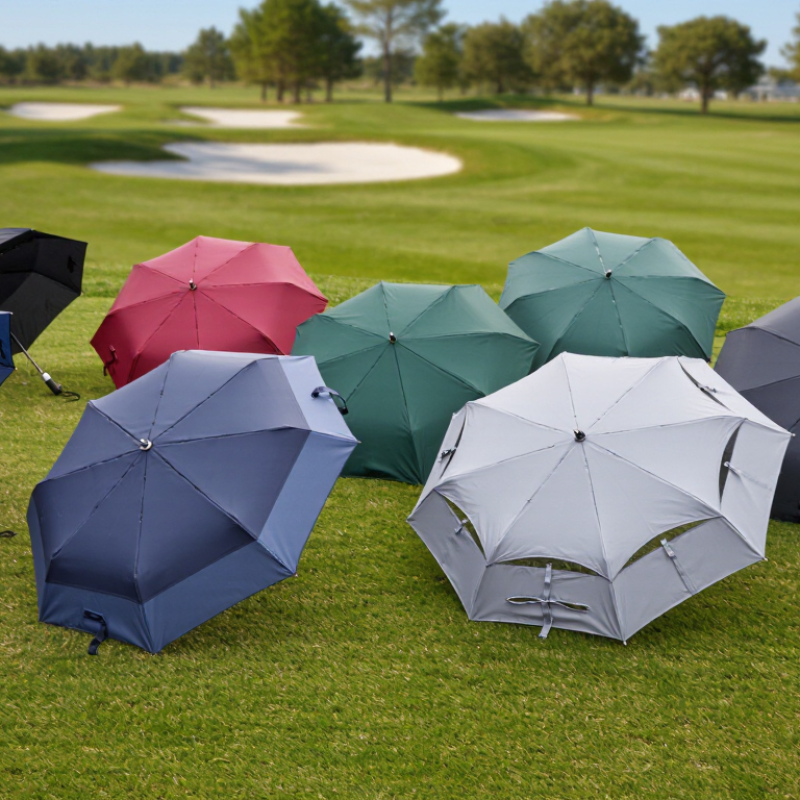
A useful Top 10 shortlist should compare weight against canopy size, not weight alone. Weight alone misleads. A 150 g umbrella may feel effortless, but its canopy can leave a golfer’s shoulders exposed. Models near 180–230 g often balance portability with coverage, especially when their open diameter reaches 120–130 cm. For many buyers, this range offers comfortable carry without making the umbrella feel fragile.
Umbrellas weighing 250–300 g usually provide larger canopies, stronger ribs, and better shaft stability. A 140 cm canopy can shelter both a golfer and a bag more effectively. However, extra fabric may catch sudden wind. Wind changes everything. Umbrellas between 320 and 350 g commonly feel more secure during heavy rain, yet they can become tiring during long walks across a course. The best choice depends on walking distance, climate, and storage space.
For a reliable comparison, buyers should check net weight, open canopy diameter, rib count, shaft material, and packed length. I recommend weighing each umbrella independently, because published figures may exclude the sleeve or strap. Measure coverage at shoulder height, not only from the canopy edge. That sounds simple. It is not always consistent. A practical test includes opening the umbrella repeatedly, carrying it for nine holes, and checking whether the frame flexes. Some very light models perform well in calm weather but feel disappointing in gusts. Others sacrifice a few grams for noticeably better balance and protection.
| Profile | Weight | Open Canopy Diameter | Approx. Coverage Area | Closed Length | Rib Count | Opening Type | Canopy Fabric | Shaft / Rib Construction | Best Use Case |
|---|---|---|---|---|---|---|---|---|---|
| A — Ultralight Compact | 158 g | 115 cm | 1.04 m² | 70 cm | 8 | Manual | 190T polyester | Aluminum shaft; fiberglass ribs | Personal rain protection with minimal carry weight |
| B — Light Personal | 176 g | 120 cm | 1.13 m² | 72 cm | 8 | Manual | 190T polyester | Aluminum shaft; fiberglass ribs | One golfer or daily commuting |
| C — Travel Golf | 194 g | 125 cm | 1.23 m² | 74 cm | 8 | Manual | 210T polyester | Aluminum shaft; fiberglass ribs | Travel bags and lightweight golf luggage |
| D — Lightweight Standard | 218 g | 130 cm | 1.33 m² | 76 cm | 8 | Manual | 210T polyester | Aluminum shaft; fiberglass ribs | Balanced coverage and portability for one golfer |
| E — Reinforced Light | 236 g | 135 cm | 1.43 m² | 78 cm | 8 | Manual | 210T polyester | Steel shaft; fiberglass ribs | More canopy coverage without entering the heavy category |
| F — Mid-Size Golf | 252 g | 140 cm | 1.54 m² | 80 cm | 8 | Manual | 210T polyester | Aluminum shaft; fiberglass ribs | Full upper-body coverage for one adult |
| G — Large Lightweight | 274 g | 145 cm | 1.65 m² | 82 cm | 8 | Manual | 210T polyester | Steel shaft; fiberglass ribs | Large single-user coverage on exposed courses |
| H — Light Double-Canopy | 296 g | 135 cm | 1.43 m² | 82 cm | 8 | Manual | Double-layer polyester | Aluminum shaft; fiberglass ribs | Ventilated canopy design with moderate weight |
| I — Auto-Open Golf | 322 g | 140 cm | 1.54 m² | 84 cm | 8 | Automatic open | 210T polyester | Steel shaft; fiberglass ribs | Quick deployment between shots or during sudden rain |
| J — Maximum Light Coverage | 348 g | 150 cm | 1.77 m² | 86 cm | 8 | Manual | 210T polyester | Steel shaft; fiberglass ribs | Maximum single-user coverage within the 350 g limit |
| Coverage area is an approximate flat-circle calculation based on the listed open canopy diameter: π × (diameter ÷ 2)². Actual usable shelter area can be smaller because golf umbrella canopies are domed and segmented. Product weights are net umbrella weights and may vary slightly with handle, sleeve, and packaging specifications. | |||||||||
Lightweight golf umbrellas should be judged by measured protection, not canopy size alone. AS/NZS 4399:2017 classifies UPF 50+ as the highest rating, allowing no more than 2% ultraviolet transmission. The WHO Global Solar UV Index guidance reminds buyers that UV exposure remains relevant under scattered cloud. A dense canopy helps, but side exposure still matters. Look for fabric test results. Ask whether testing covered the finished canopy, not only a fabric sample. In practice, a 130–140-centimetre open span gives useful coverage for one golfer and equipment. Yet advertised span can measure rib tip to rib tip, overstating usable shade.
Wind claims require more skepticism. The World Meteorological Organization places 30–38 km/h in Beaufort force 5 and 39–49 km/h in force 6. A 50 km/h wind reaches the lower edge of force 7. These are outdoor wind descriptions, not an umbrella certification. A credible product page should state test speed, duration, setup, and failure criteria. Independent mechanical testing is stronger than a single marketing number. For global procurement, compare canopies at 30, 40, and 50 km/h, using the same angle and wetness. That comparison exposes weak ribs and inversion points. I would still avoid promising “stormproof” performance; gusts are uneven, and real courses add trees, slopes, and sudden direction changes. The benchmark is useful, but not perfect.
For global buyers, a lightweight golf umbrella must balance low weight with structural reliability. Fiberglass ribs flex during gusts and resist corrosion better than ordinary steel. However, flexible ribs alone cannot prevent failure. The shaft, runner, joints, and rib tips also require careful inspection. A weak connector can ruin an otherwise strong canopy.
The 190T polyester canopy is common in export umbrellas. The “T” usually indicates fabric thread density, but it is not a universal performance guarantee. Higher density may improve coverage and tear resistance, yet coating quality and seam construction remain critical. Textile Exchange’s Materials Market Report 2024 reported that polyester represented about 57% of global fiber production in 2023. This supports polyester’s wide industrial use, but not every 190T fabric performs equally. That distinction matters.
ISO 5912 testing gives buyers a clearer reference point. The standard addresses umbrella construction, opening and closing functions, corrosion resistance, colorfastness, and wind-related performance. Requesting test records is more reliable than trusting terms such as “stormproof.” Check whether the tested sample matches the production model. Sometimes it does not. Field inspections should examine rib alignment, canopy leakage, handle bonding, and repeated opening cycles. The World Meteorological Organization’s State of the Global Climate reports continued weather volatility, making practical wind testing increasingly relevant. A compact frame is useful, but it should not feel fragile in the hand.
Top 10 Lightweight Golf Umbrellas for Global Buyers
Global Buyer Scorecard: Weight, Coverage, Packability, Warranty, and Price
A practical scorecard should compare more than advertised weight. A comfortable golf umbrella usually weighs under 500 grams, yet frame strength still matters. Coverage should protect both golfer and bag, especially during side-driven rain. I look for canopies near 120 centimeters wide, with reinforced ribs and a smooth opening system. Small details matter. A slippery handle can become frustrating on a wet course.
Packability affects travel costs and daily convenience. Check the closed length before buying, because a wide canopy may still fit poorly inside luggage. For international buyers, warranty terms deserve careful reading. Confirm coverage duration, proof-of-purchase rules, return shipping, and regional service limits. A low price can become expensive when replacement shipping crosses borders. My score is practical, not perfect. Wind behavior remains difficult to predict.
Tips: Weigh the umbrella with its sleeve. Test the handle with wet hands. Compare final prices after tax and delivery. Choose corrosion-resistant hardware for humid regions. A basic vent can reduce sudden lifting, but it cannot guarantee stability in severe weather. Also, avoid trusting one impressive specification. Real comfort depends on balance, opening force, storage space, and repeated use.
Global Buyer Scorecard: Weight, Coverage, Packability, Warranty, and Price
Scores are normalized from 0 to 10 using published retail specifications for lightweight golf umbrellas. Higher scores indicate lower weight, larger usable coverage, more compact packed size, longer warranty coverage, and better price value. Price scores reflect typical retail pricing in USD, excluding taxes and shipping.
A useful ranking starts with safety, not appearance. I recommend assigning safety 40%, durability 35%, and value 25%. Safety checks should include wind resistance, frame locking, rounded tips, and handle grip. A lightweight umbrella should not feel fragile during a sudden course-side gust. Testers can inspect opening force, canopy stability, and rib movement after repeated use. Small failures matter.
Durability needs practical evidence. Look for reinforced canopy seams, corrosion-resistant shafts, flexible ribs, and stitching that remains tight after drying. A 250-gram umbrella may be convenient, but excessive weight reduction can weaken the frame. In product evaluations, I also consider packed size, repair options, shipping damage, and warranty clarity. No score is perfect. A short indoor test may miss problems caused by salt air or repeated folding.
Tips: Record each model’s weight, canopy width, and folded length. Use the same wind and rain conditions for every test. Add landed cost when comparing international value. A low purchase price can change after shipping, taxes, or replacement parts. Also, ask whether the grip stays comfortable with wet hands. That detail seems minor. It is not. My own scoring would leave room for revision, because real golfers use umbrellas differently across climates, courses, and seasons.
